Design Patterns are reusable solutions to common problems in object-oriented design. The 23 classic patterns were systematized by the Gang of Four (GoF: Erich Gamma, Richard Helm, Ralph Johnson, John Vlissides) in their 1994 book Design Patterns: Elements of Reusable Object-Oriented Software.
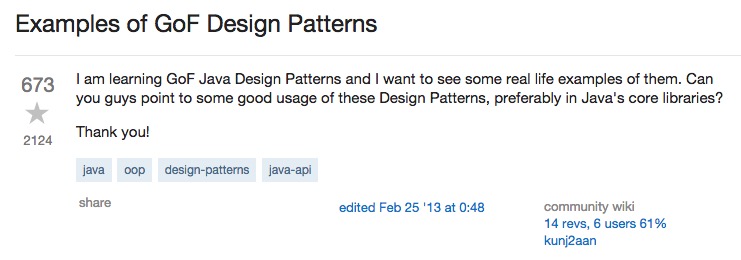
This article is compiled from a blog post by smallnest and a StackOverflow discussion on GoF design pattern implementations in the Java API.
Design patterns are not code libraries — they are conceptual frameworks for solving problems. The key is understanding when to use a pattern, not just how to implement it.
Creational Patterns
Creational patterns abstract the instantiation process, making a system independent of how its objects are created, composed, and represented.
Abstract Factory
Recognizable by: creational methods returning the factory itself, which in turn creates another abstract/interface type.
Java API Examples:
javax.xml.parsers.DocumentBuilderFactory#newInstance()javax.xml.transform.TransformerFactory#newInstance()javax.xml.xpath.XPathFactory#newInstance()
Builder
Recognizable by: creational methods returning the instance itself (fluent API).
Java API Examples:
java.lang.StringBuilder#append()(unsynchronized)java.lang.StringBuffer#append()(synchronized)java.nio.ByteBuffer#put()(also CharBuffer, ShortBuffer, IntBuffer, LongBuffer, FloatBuffer, DoubleBuffer)javax.swing.GroupLayout.Group#addComponent()- All implementations of
java.lang.Appendable
Factory Method
Recognizable by: creational methods returning an implementation of an abstract/interface type.
Java API Examples:
java.util.Calendar#getInstance()java.util.ResourceBundle#getBundle()java.text.NumberFormat#getInstance()java.nio.charset.Charset#forName()java.net.URLStreamHandlerFactory#createURLStreamHandler(String)(returns singleton per protocol)
Prototype
Recognizable by: creational methods returning a different instance of itself with the same properties.
Java API Examples:
java.lang.Object#clone()(class must implementjava.lang.Cloneable)
Singleton
Recognizable by: creational methods returning the same instance every time.
Java API Examples:
java.lang.Runtime#getRuntime()java.awt.Desktop#getDesktop()
Structural Patterns
Structural patterns focus on how classes and objects are composed to form larger structures.
Adapter
Recognizable by: creational methods taking an instance of a different abstract/interface type and returning an implementation of own/another abstract/interface type that decorates/overrides the given instance.
Java API Examples:
java.util.Arrays#asList()java.io.InputStreamReader(InputStream)(returns a Reader)java.io.OutputStreamWriter(OutputStream)(returns a Writer)javax.xml.bind.annotation.adapters.XmlAdapter#marshal()and#unmarshal()
Bridge
Recognizable by: creational methods taking an instance of a different abstract/interface type and returning an implementation that delegates/uses the given instance.
Java API Examples:
JDBC, JNDI, JCE are the classic examples. No direct JDK class comes to mind. java.util.Collections#newSetFromMap() and singletonXXX() methods come close.
Composite
Recognizable by: behavioral methods taking an instance of the same abstract/interface type into a tree structure.
Java API Examples:
java.awt.Container#add(Component)(all over Swing)javax.faces.component.UIComponent#getChildren()(all over JSF)
Decorator
Recognizable by: creational methods taking an instance of the same abstract/interface type and adding additional behavior.
Java API Examples:
- All subclasses of
java.io.InputStream,OutputStream,Reader,Writerhave constructors taking the same type java.util.CollectionscheckedXXX(), synchronizedXXX(), unmodifiableXXX() methodsjavax.servlet.http.HttpServletRequestWrapperandHttpServletResponseWrapper
Facade
Recognizable by: behavioral methods that internally use instances of different independent abstract/interface types.
Java API Examples:
javax.faces.context.FacesContext— internally uses LifeCycle, ViewHandler, NavigationHandler, etc.javax.faces.context.ExternalContext— internally uses ServletContext, HttpSession, HttpServletRequest, etc.
Flyweight
Recognizable by: creational methods returning a cached instance (the “multiton” idea).
Java API Examples:
java.lang.Integer#valueOf(int)(also Boolean, Byte, Character, Short, Long)- String constant pool
Proxy
Recognizable by: creational methods returning an implementation that delegates/uses a different implementation.
Java API Examples:
java.lang.reflect.Proxyjava.rmi.*— the entire API
Behavioral Patterns
Behavioral patterns focus on how objects distribute responsibilities and interact.
Chain of Responsibility
Recognizable by: behavioral methods that (indirectly) invoke the same method in another implementation of the same type in a queue.
Java API Examples:
java.util.logging.Logger#log()javax.servlet.Filter#doFilter()
Command
Recognizable by: behavioral methods in an abstract/interface type that invoke a method in a different type, encapsulated during creation.
Java API Examples:
- All implementations of
java.lang.Runnable - All implementations of
javax.swing.Action
Interpreter
Recognizable by: behavioral methods returning a structurally different instance/type of the given instance/type.
Java API Examples:
java.util.Patternjava.text.Normalizer- All subclasses of
java.text.Format - All subclasses of
javax.el.ELResolver
Iterator
Recognizable by: behavioral methods sequentially returning instances of a different type from a queue.
Java API Examples:
- All implementations of
java.util.Iterator - All implementations of
java.util.Enumeration
Mediator
Recognizable by: behavioral methods taking an instance of a different abstract/interface type and delegating/using it.
Java API Examples:
java.util.Timer(all scheduleXXX() methods)java.util.concurrent.Executor#execute()java.util.concurrent.ExecutorService(invokeXXX() and submit() methods)java.util.concurrent.ScheduledExecutorService(all scheduleXXX() methods)java.lang.reflect.Method#invoke()
Memento
Recognizable by: behavioral methods that internally change the state of the whole instance.
Java API Examples:
java.util.Date(setters change the internal long value)- All implementations of
java.io.Serializable - All implementations of
javax.faces.component.StateHolder
Observer (Publish/Subscribe)
Recognizable by: behavioral methods that invoke a method on another abstract/interface type instance, depending on own state.
Java API Examples:
java.util.Observer/java.util.Observable(rarely used in practice)- All implementations of
java.util.EventListener(all over Swing) javax.servlet.http.HttpSessionBindingListenerjavax.servlet.http.HttpSessionAttributeListenerjavax.faces.event.PhaseListener
State
Recognizable by: behavioral methods that change behavior depending on the instance’s state, which can be controlled externally.
Java API Examples:
javax.faces.lifecycle.LifeCycle#execute()(behavior depends on the current JSF lifecycle phase)
Strategy
Recognizable by: behavioral methods in an abstract/interface type that invoke a method in a different abstract/interface type passed in as a method argument.
Java API Examples:
java.util.Comparator#compare()(executed byCollections#sort())javax.servlet.http.HttpServlet— service() and all doXXX() methodsjavax.servlet.Filter#doFilter()
Template Method
Recognizable by: behavioral methods in an abstract type that already have a “default” behavior defined.
Java API Examples:
- All non-abstract methods of
java.io.InputStream,OutputStream,Reader,Writer - All non-abstract methods of
java.util.AbstractList,AbstractSet,AbstractMap javax.servlet.http.HttpServlet— all doXXX() methods default to HTTP 405
Visitor
Recognizable by: two different abstract/interface types that each have methods taking the other type; one calls the other’s method to execute the desired strategy.
Java API Examples:
javax.lang.model.element.AnnotationValueandAnnotationValueVisitorjavax.lang.model.element.ElementandElementVisitorjavax.lang.model.type.TypeMirrorandTypeVisitor
References
- Original post: smallnest/Design Patterns Cheatsheet
- Design Patterns: Elements of Reusable Object-Oriented Software — GoF
- CMU Course: “23 Patterns in 80 Minutes” by Josh Bloch
- GoF Design Patterns in Java — Alibaba Cloud
- Java Design Patterns — Wikipedia